
Solution
Fuel monitoring
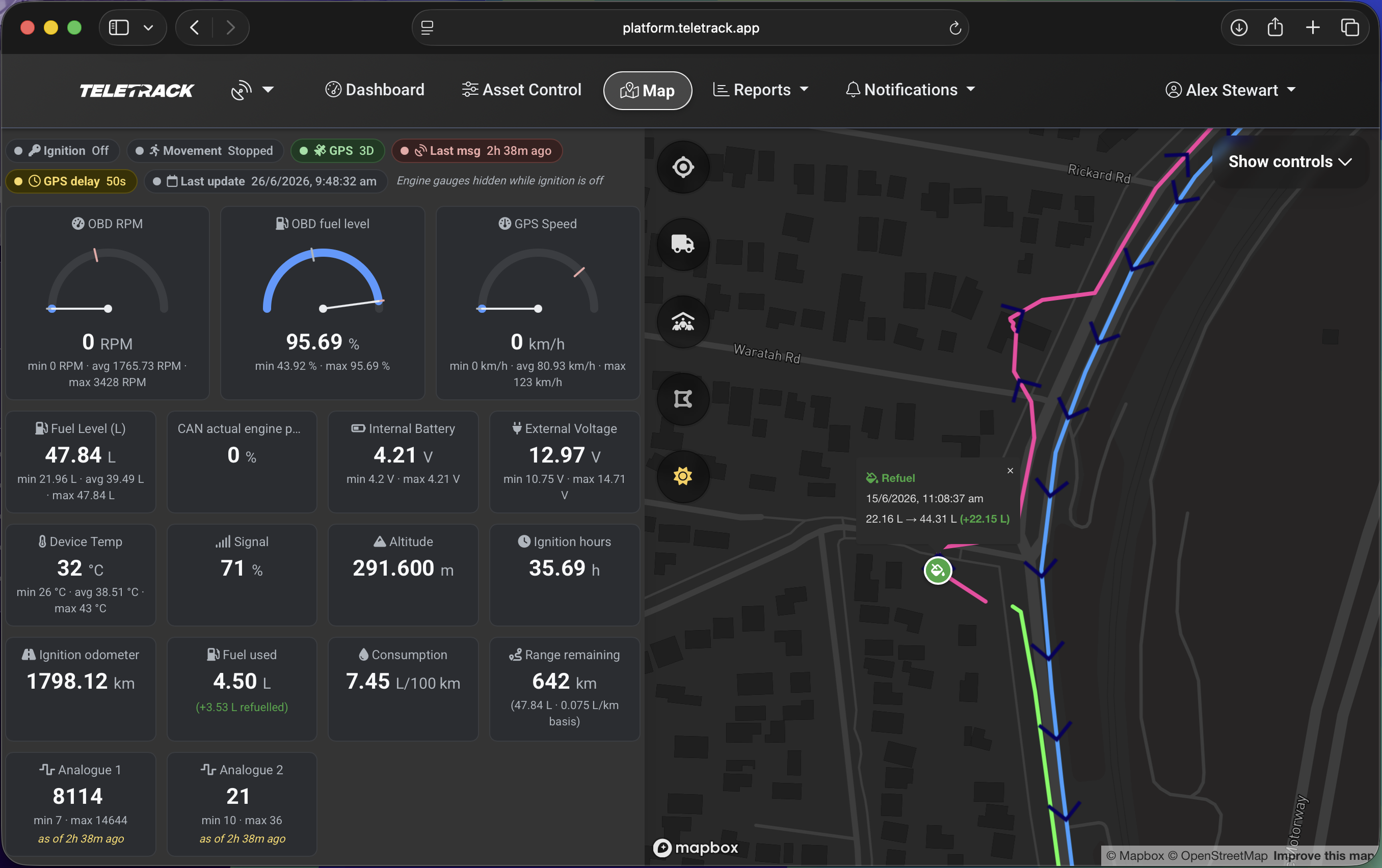
Idling detection plus fuel-level and fuel-flow monitoring — read from the asset's CAN bus, Bluetooth fuel-level sensors (we sell the Escort TD BLE), or analogue voltage probes wired to the tracker. For AU diesel fleets.
What it does
Three pieces, all live today
Idling detection
Every hardwired and OBD-capable device reports engine-on time vs engine-on-moving time. Excess idling shows up in driver scorecards, asset utilisation reports, and the map view. Useful for diesel cost reduction and for identifying machines that are running but not earning.
Fuel level + flow monitoring
Live tank level or flow on supported hardwired trackers. Three sensor options: read from the asset's CAN bus (least intrusive, quick to set up), pair a Bluetooth fuel-level sensor like the Escort TD BLE we stock for fuel pods, or wire an analogue voltage-based fuel-level probe into the tracker's input. Useful for fuel theft detection, refuel verification, and consumption-per-hour reporting on heavy plant.
Per-asset fuel reporting
Engine hours and kilometres roll up per asset, per site, and per period — broken down into idling and working time. Useful for cost allocation, route efficiency, and project-by-project fuel cost reporting.
Sensor integration
How fuel-level monitoring works
Three sensor paths into the platform — pick the one that fits the asset.
-
1
Option 1 — read it off the asset's CAN bus
Least intrusive and quickest to set up on plant that already publishes fuel data on CAN. No extra sensor hardware, no tank work — the tracker reads fuel level / flow from the existing bus. Available on hardwired CAN-capable trackers (Smart5, FMM250 / FMM650 / FMC650; TrakaX® Series 2 on special order).
-
2
Option 2 — Bluetooth fuel-level sensor (Escort TD BLE)
We stock and sell the Escort TD BLE wireless fuel-level sensor. The sensor pairs over Bluetooth directly to the BLE-capable tracker — Digital Matter G70-BLE, Teltonika FMM250 / FMC650 / FMM650, and Ruptela Smart5 — with no analogue wiring through the cab. Common on fuel pods and stationary tanks where running cable would be intrusive.
-
3
Option 3 — analogue voltage-based fuel-level probe
Aftermarket analogue probes (the traditional resistive / voltage-output level senders) wired into one of the tracker's analogue inputs. Works on the same hardwired tracker list as the BLE option. Useful on older plant without a CAN fuel signal and where a wired install is acceptable.
-
4
Read it in the platform
Fuel level shows up in the map view and history playback regardless of which sensor source you used. Drops outside refuel events trigger alerts. Flow rates aggregate into per-asset and per-job consumption reports.
Hardware compatibility
Hardware that supports fuel-level monitoring
Fuel-level and fuel-flow monitoring runs on the hardwired trackers in the lineup. Per-sensor-type compatibility:
- Digital Matter G70-BLE — BLE (Escort TD BLE) and analogue voltage inputs; no CANBUS.
- TrakaX® Series 2 — Australian-designed, PROSTART-native; CAN and analogue voltage inputs.
- Teltonika FMM250 — BLE (Escort TD BLE) and analogue voltage inputs on the hardwired fleet model.
- Teltonika FMM650 — heavy-fleet flagship; CAN, BLE (Escort TD BLE), and analogue voltage inputs.
- Teltonika FMC650 — dashcam-pairing telematics device; same input set as the FMM650 (CAN, BLE, analogue voltage).
- Ruptela Smart5 — hardwired heavy-vehicle device; CAN, BLE (Escort TD BLE), and analogue voltage inputs.
Idling detection works on all hardwired and OBD-capable devices in the lineup. Battery trackers (Digital Matter Barra GPS, Ruptela Asset5) report position but don't read engine state, so idling and fuel-level monitoring don't apply to them.
Per-asset reporting
Fuel Tax Credit reporting for AU fleets
Per-asset fuel reporting shows where the diesel is actually burned — idling, working, and on / off the road. That breakdown is what most fleets are missing when they try to do project-level cost allocation or driver coaching.
Reports are produced in Excel and PDF. CSV is available on request if a downstream system needs it. Polished accountant-ready templates are still evolving — if you need a specific format we'll build it as part of onboarding.
FTC (Fuel Tax Credit) reporting: not a feature yet. Per-asset fuel data is captured and exportable today, but we don't produce an ATO-format FTC report. On the roadmap; not available today.
Where customers use this
Civil contractors
Per-asset fuel and engine-hour reporting on dozers, excavators, loaders, and ADTs. Idling reduction to bring diesel cost per engine hour down.
Transport and logistics
Heavy-vehicle on-road fuel reporting, fuel-level monitoring on prime movers, fuel theft alerts.
Mining and quarry contractors
Per-asset fuel and engine-hour reporting on auxiliary equipment, dozers, and haul trucks. Fuel flow on key assets.
Equipment hire
Charge-by-fuel-use on hired plant, fuel-level checks at hire-out and hire-back.
Common questions
Do you sell fuel-level sensors?
Yes — we stock and sell the Escort TD BLE wireless fuel-level sensor, which is the sensor we use on fuel pods and stationary tanks because it pairs over Bluetooth straight to the tracker — no analogue wiring through the cab. For other sensor brands or analogue-voltage probes we integrate third-party aftermarket sensors as well; your auto-electrician or our install partner wires those into a hardwired tracker.
Can I do fuel monitoring on a battery tracker?
No. Battery trackers (Barra GPS, Asset5) report position only — they don't read engine state or sensor inputs. Fuel-level, fuel-flow, and idling all need a hardwired device.
What hardware do you recommend for fuel?
The TrakaX® Series 2 (AU-designed, CAN-capable, PROSTART-native), Digital Matter G70-BLE, Teltonika FMM650 or FMC650, or Ruptela Smart5. All but the G70-BLE read fuel data off CAN; the G70-BLE takes the Escort TD BLE or an analogue probe. The right pick depends on your fleet mix — talk to us in a demo.
How is idling detected?
Idling can be measured a few different ways depending on the tracker and the asset. On heavy plant or vehicles that publish engine telemetry, we can use engine RPM — RPM above the running threshold while the asset isn't moving counts as idling. Other approaches are available case-by-case depending on what the tracker can see from the asset.
The Teletrack platform's consistent default — the method that works across the broadest hardware set — is time at a specific location with the ignition on: the asset is stationary inside a geofenced location, the ignition is detected as on, and the duration crosses the threshold you've set. Reports show idling per asset, per operator, and per day.
Is fuel monitoring extra, or included in the standard plan?
Idling is included in the Track plan at $21.90 / asset / month. Fuel-level and fuel-flow monitoring need a hardwired tracker, plus a fuel sensor (the Escort TD BLE we sell, or a third-party probe) where the asset doesn't publish fuel data on its CAN bus, but there's no extra platform fee for reading them.
Do you have ESG / CO₂ reporting?
Not as a productised dashboard today. CO₂ from fuel burn is on the roadmap. Driver scorecards cover idling, harsh events, and speed today — those are the components that proxy for eco-driving.
Can fuel use be allocated to a specific job or site?
Not as a built-in feature today. Site / job allocation of fuel use is on the roadmap, and can be scoped as a custom build on request. In the meantime, per-asset fuel data is exportable to Excel or PDF and can be reconciled against site or job data manually.
See fuel monitoring on your fleet
We'll walk through idling reporting, fuel sensor integration on your specific hardware, and what per-asset fuel reporting looks like for your fleet. 30 minutes.
More solutions
View all →PROSTART® pre-starts
Pre-starts that immobilise across every hardwired tracker we sell — Digital Matter, Teltonika, Ruptela, and TrakaX®. HammerTech-integrated.
Asset tracking
Live GPS, geofencing, history playback, and theft-response assistance — we'll help you mobilise a police-accessible live tracking link when an asset goes missing. From $21.90 / asset / month.
Maintenance
Draft work orders raised by engine hours, kilometres, schedule, or failed pre-start questions set up to create one. Parts inventory. Technician tablet workflows with photo and signature capture.
Ready to see Fuel monitoring in action?