
Solution
CRM + email marketing
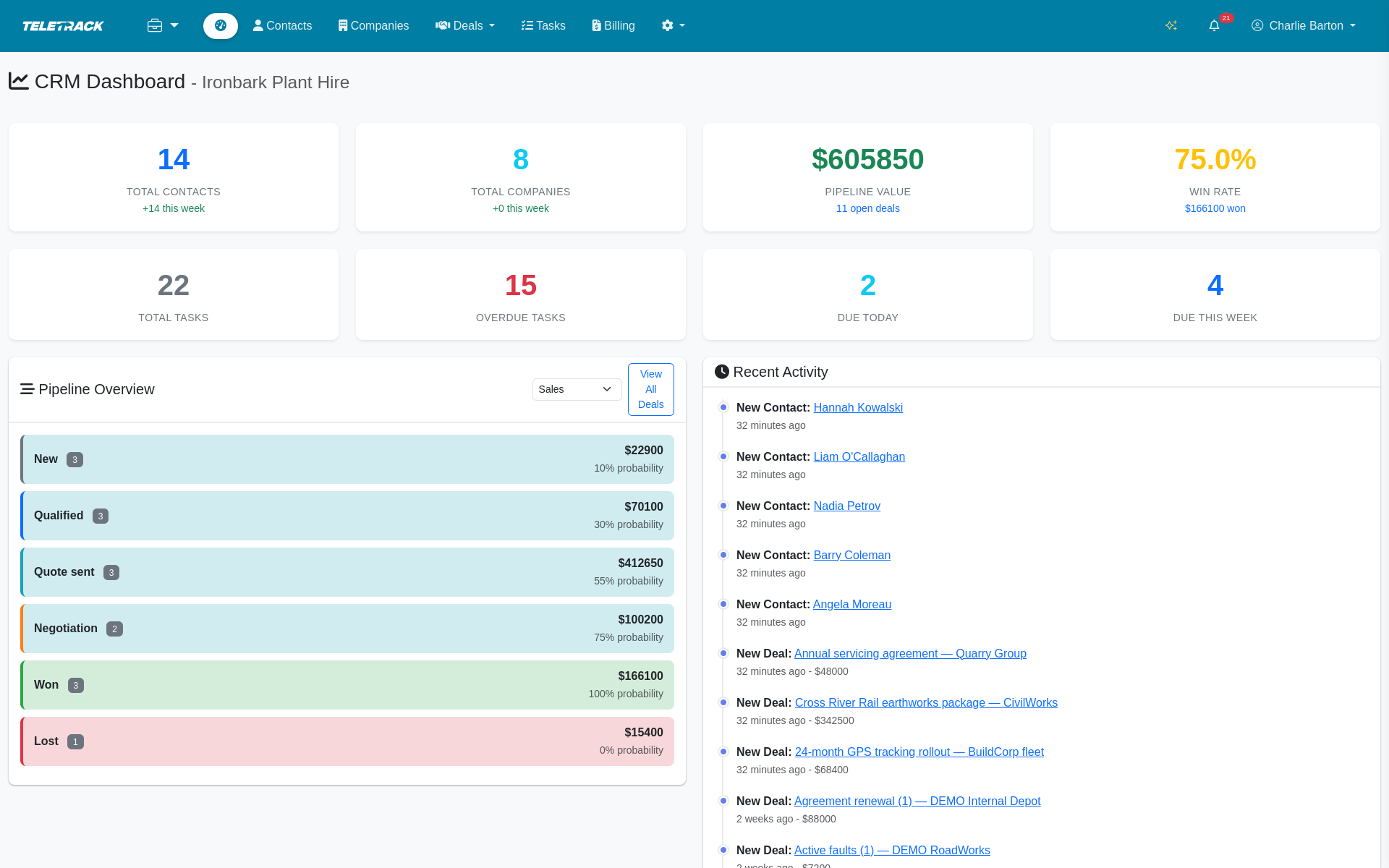
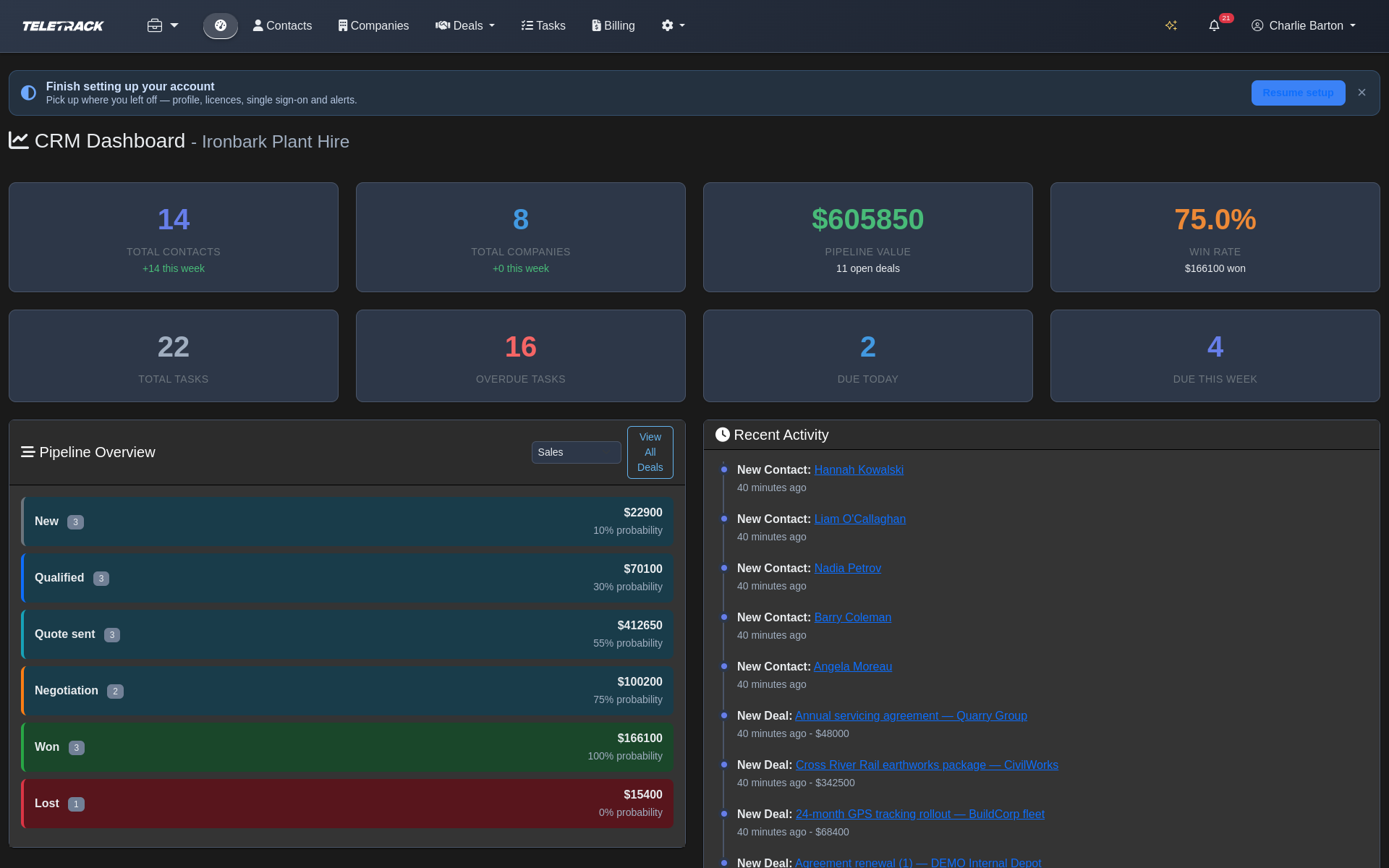
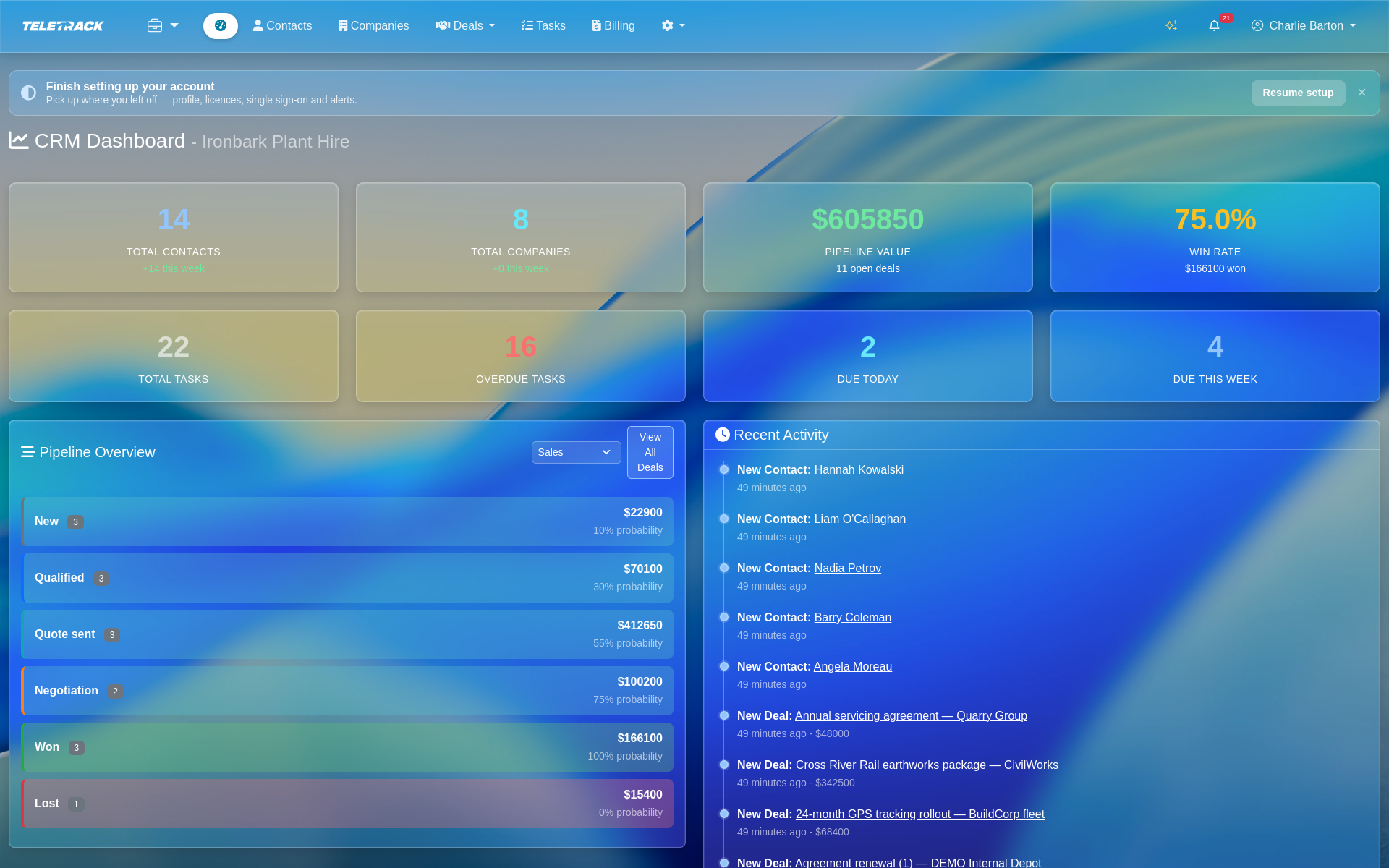
Built-in CRM and email marketing inside the fleet platform. Hire customers, OEM dealers, end users — and safety nudges to operators.
What's built in
Four pieces, all inside the platform
Customer records
Full CRM contact and company records — linked directly to the assets on hire, sold, or under service. History, notes, custom fields, tagging.
Marketing campaigns
Email campaigns built and sent inside the platform. Segment by customer type, asset type, location, or any custom field. Track opens, clicks, and replies.
Automated email sequences
Trigger-based sequences — welcome flow for a new hire customer, renewal reminder when a hire is ending, service follow-up after a maintenance job, operator safety nudge after a failed pre-start.
Hire-customer lifecycle
From quote to hire-out to hire-back to invoice follow-up. Built around how AU hire businesses actually run.
Who uses it
Three ways customers use the built-in CRM
Hire businesses managing customer relationships
Primary customer database — quote follow-ups, hire-out confirmations, hire-back reminders, overdue-return chases, renewal upsells. Integrates with HirePOS, MCS, Syrinx, and Latner so customer records sync from the ERP automatically.
OEM whitelabel partners managing dealer networks
OEM whitelabel partners use the CRM to manage their dealer network and the dealer's end customers. Each dealer sees their own customers; the OEM sees all of them. Branded campaigns go out under the OEM brand.
Marketing campaigns to operators
The unusual one. Most fleet platforms market past operators — straight to the fleet owner. Teletrack lets you market to operators directly. Safety nudges, ticket renewals, induction follow-up, recognition emails.
Platform integration
How the CRM connects to the rest of the platform
Not a bolt-on. Shares the same database as every other module.
- Asset records link to customer records. Every hired asset knows who hired it, when, and for how long.
- Service history triggers renewal reminders. A 250-hour service due on an asset triggers an email to the asset's owner.
- Pre-start failures trigger operator safety campaigns. A failed pre-start on a high-risk question triggers a training nudge to the operator (see PROSTART®).
- Ticket expiry triggers a renewal email. From the Inductions module, ticket and licence expiries fire scheduled renewal emails to operators.
Differentiation
Built-in CRM vs bolt-on integration
| Feature | Teletrack | Typical AU telematics platforms |
|---|---|---|
| Where the CRM lives | Inside the fleet platform — same database | Separate tool (HubSpot, Salesforce, Mailchimp) stitched via integration |
| Segmenting by telematics data | Native — asset utilisation, scorecard, pre-start pass rate, geographic area | Possible only through custom integration |
| Triggering sequences from platform events | Native — pre-start failures, ticket expiry, hire-back date | Requires webhook plumbing and a third-party automation tool |
| Operator marketing | Supported — email + native app push | Not a use case the stack supports |
| Cost | Included in Track plan; no per-contact or per-email fee | Separate CRM seats + separate email-platform contact tier |
Industries
Industries using the built-in CRM
Equipment Hire
Primary use case, paired with ERP integrations.
See Equipment Hire →OEM whitelabel partners
Dealer-network and end-customer management.
See whitelabel →Tier 1 & 2 Construction
Operator safety campaigns, ticket renewals.
See Tier 1 & 2 Construction →Service businesses
Service-renewal reminders driven by hours and kilometres.
See Service businesses →Common questions
Is the CRM a separate product or part of the platform?
Part of the platform. It runs on the same database as asset tracking, maintenance, pre-starts, portal sharing, and everything else. Same login, same accounts, same permissions model.
Can I import my existing customer database?
Yes — CSV import for contacts, companies, and custom fields. If you're on HirePOS, MCS, Syrinx, or Latner the integration syncs customers automatically — no double-entry.
Can I segment campaigns by telematics data?
Yes — that's a core differentiator. Segment by asset type, asset utilisation, customer hire history, operator scorecard, pre-start pass rate, geographic area, or any custom field. Then send a targeted campaign.
Are emails sent from my domain or Teletrack's?
Your domain. Customers configure their own sending domain with SPF, DKIM, and DMARC — emails appear to come from your business, not from Teletrack.
How does operator marketing actually work — operators are on machines, not at desks?
Two channels. Email goes to the operator's personal address (which you capture during induction or operator setup). For higher-frequency contextual nudges, the native iOS / Android operator app (available now via the App Store and Google Play) handles in-app nudges — native push notifications coming soon — the same app they use for pre-starts and dockets.
Can I use my existing CRM (HubSpot, Salesforce, etc.) instead?
Yes — you don't have to use Teletrack's built-in CRM. Public API and webhooks make integrating with your existing CRM straightforward. But for most hire businesses and OEM partners, the built-in CRM removes a tool from the stack.
Is the CRM extra, or included?
Included in the Track plan and above. No per-contact pricing. No per-email pricing. You pay per asset; the CRM comes with the platform.
What stops me from spamming my operators?
Standard email marketing best practice — opt-out support, unsubscribe links, frequency caps, and segmentation by behaviour. Operator-facing campaigns are best run as low-frequency, high-relevance nudges (a renewal reminder when a ticket expires, not a weekly newsletter).
See the built-in CRM on your fleet
We'll show you customer records linked to assets, marketing campaigns built and sent from inside the platform, automated sequences firing off telematics events, and the operator marketing flow. 30 minutes.
More solutions
View all →PROSTART® pre-starts
Pre-starts that immobilise across every hardwired tracker we sell — Digital Matter, Teltonika, Ruptela, and TrakaX®. HammerTech-integrated.
Asset tracking
Live GPS, geofencing, history playback, and theft-response assistance — we'll help you mobilise a police-accessible live tracking link when an asset goes missing. From $21.90 / asset / month.
Maintenance
Draft work orders raised by engine hours, kilometres, schedule, or failed pre-start questions set up to create one. Parts inventory. Technician tablet workflows with photo and signature capture.
Ready to see CRM + email marketing in action?