
Solution
Diagnostics
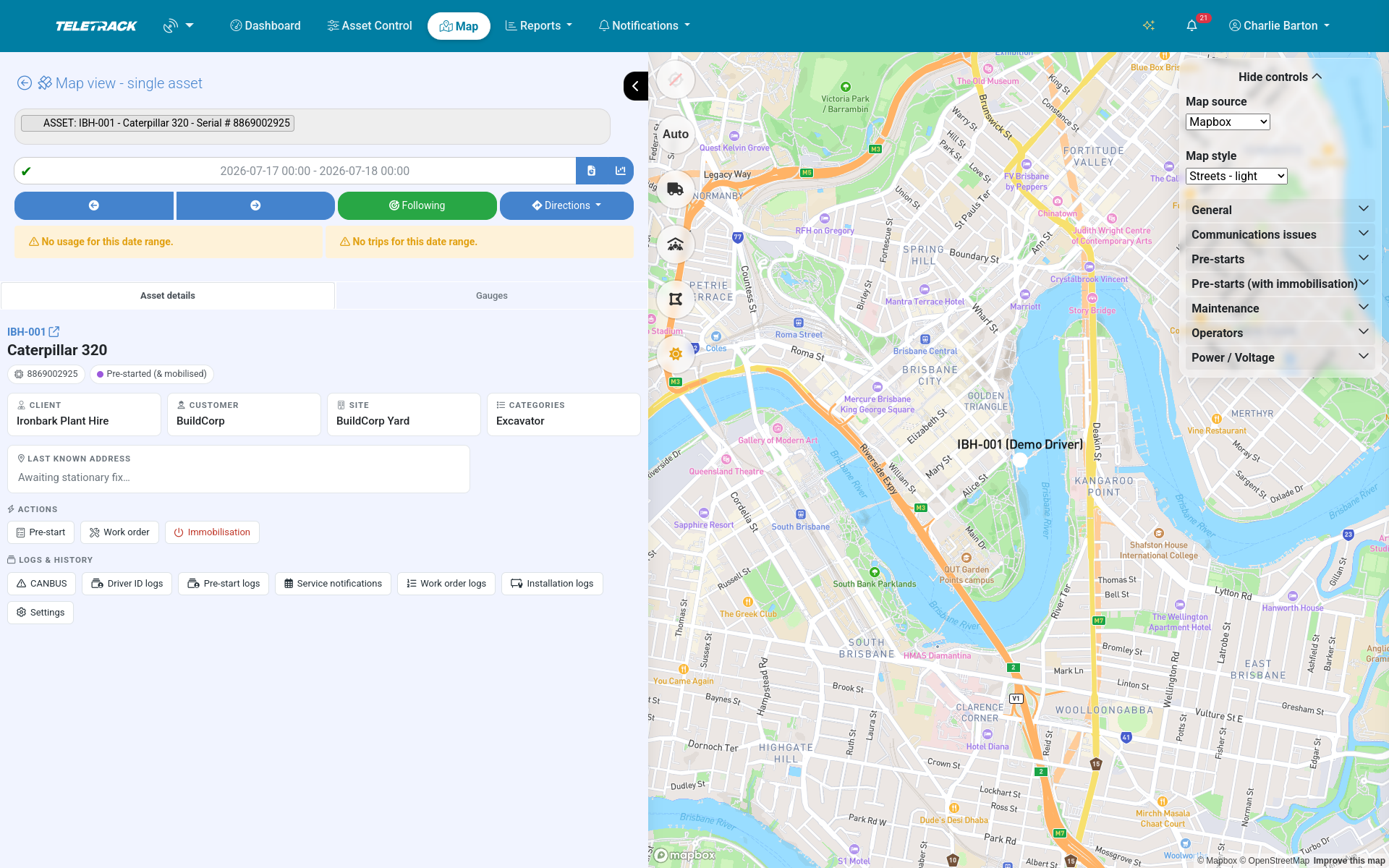
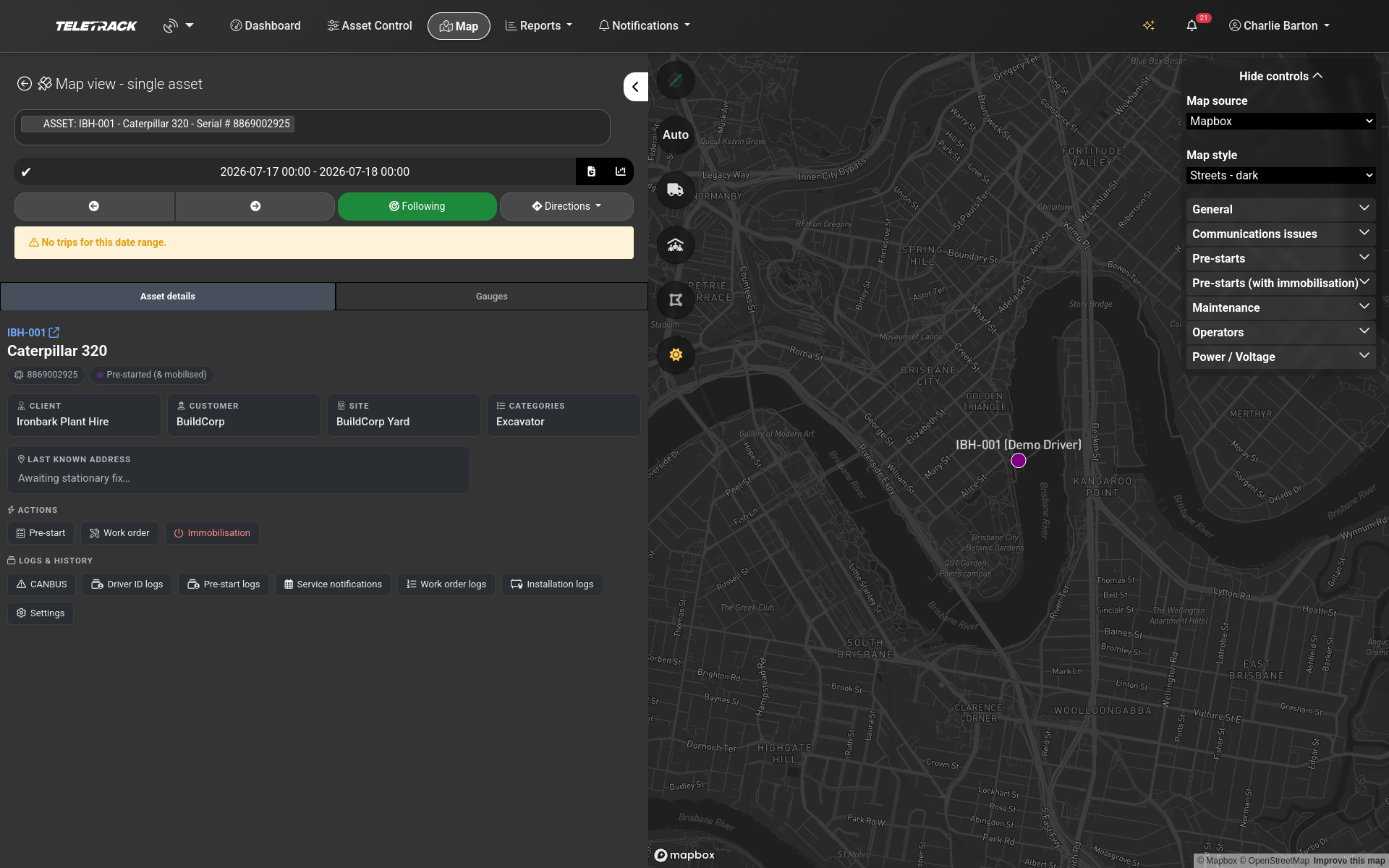
CANBUS / J1939 fault code reading on supported hardwired devices. Custom OEM libraries on TrakaX® Series 2 and Teltonika FMM650 / FMC650.
Included in the Track tier
$21.90 / asset / month on supported hardware. Custom OEM library work scoped per asset class if outside standard coverage.
What it reads
What CANBUS / J1939 reading pulls off the machine
The data is already on the machine — diagnostics surfaces it on the platform.
Engine hours + odometer
The most reliable source of usage data. On an asset set to use them, they drive its hour meter and odometer, which the hour- and km-based service rules read.
Fuel flow + tank level
Fuel consumption per hour, per km, per trip. Idle fuel waste. Refuel events with location and amount.
See fuel monitoring →Fault codes
J1939 (heavy diesel) and OBD-II (light vehicle) fault codes read in real time. Code, description (where the OEM library supports it) and timestamp.
Custom OEM data points
RPM, coolant temperature, oil pressure, hydraulic pressure, attachment status, machine mode — anything the OEM exposes on the CAN bus. Custom-library work scopes the specific data points per asset class.
Hardware
Hardware that reads CANBUS / J1939
Diagnostics is hardware-dependent — the device needs a CAN connection and the firmware to decode it.
| Device | CANBUS / J1939 | OBD-II | Custom OEM library | Notes |
|---|---|---|---|---|
| TrakaX® Series 2 | Yes | Yes | Strongest custom OEM coverage | AU-designed; our own hardware and firmware — deepest custom-library support. |
| Teltonika FMM650 | Yes | Yes | Strong custom OEM coverage | Heavy haulage; broad reverse-engineered CAN library, custom OEM codes loaded when available. |
| Teltonika FMC650 | Yes | Yes | Strong custom OEM coverage | Heavy haulage + dashcam; same CAN coverage as FMM650. |
| Teltonika FMM250 | Yes | Yes | Reverse-engineered library | Hardwired fleet vehicle tracker; reverse-engineered CAN library loaded onto the device. |
| Ruptela Smart5 | Yes | Yes | Strong custom OEM coverage | Hardwired fleet / plant tracker; reverse-engineered CAN library plus custom OEM codes loaded when available. |
| Teltonika FMM003 | No | Yes | — | OBD-II plug-in only; reads OBD-II fault codes, no full CANBUS / J1939. |
| Ruptela Plug5 | No | Yes | — | OBD-II plug-in only; reads OBD-II fault codes, no full CANBUS / J1939. |
| Digital Matter G70-BLE | No | No | — | Hardwired plant tracker; not used for CANBUS diagnostics work. |
| Digital Matter Barra GPS | No | No | — | Battery tracker; no CAN connection. |
| Ruptela Asset5 | No | No | — | Battery tracker; no CAN connection. |
The three devices we lead with for diagnostics-heavy fleets are TrakaX® Series 2, Teltonika FMM650, and Teltonika FMC650 — the broadest CAN library coverage in the range, with custom OEM codes loaded when we have them.
Custom OEM libraries
When standard CAN isn't enough
Most fleet vehicles publish CAN data in standard J1939 or OBD-II formats. Heavy plant is messier. Each OEM (Caterpillar, Komatsu, Hitachi, Volvo, Liebherr, JCB, Bobcat, etc.) often publishes proprietary data points outside the standard codes — machine mode, attachment status, hydraulic system state, payload data.
The Teltonika and Ruptela units ship with reverse-engineered CANBUS libraries that get loaded onto each device. Coverage is broad but not universal. For the specific parameters supported on a given vehicle or machine, check the vendor's CANBUS spreadsheet — Teltonika and Ruptela publish these per device. Check it against your OEM mix before assuming a data point is there.
Where Teletrack already has the proprietary CANBUS codes for a vehicle — or where an OEM, fleet, or hire company supplies them to us — we load those codes directly into the device. The relevant CANBUS data then flows to the server alongside the standard reverse-engineered library.
Custom OEM library work is when we build a decoder for a specific OEM / model so the platform can read those proprietary data points and present them in the dashboard.
- TrakaX® Series 2 has the strongest custom OEM library support — our own hardware, our own firmware, no waiting on a third party.
- Teltonika FMM650 / FMC650 also support custom CAN decoder uploads — broad coverage of European OEMs in particular.
- Ruptela Smart5 also supports custom OEM codes loaded onto the device on top of the standard reverse-engineered library.
- Standard libraries cover most general fleet and plant. Custom work is scoped when the data you need isn't in the standard set.
Talk to us about your specific OEM mix — we'll tell you whether the data points you want are in the standard libraries or need a custom build.
Pairs well with
Maintenance
The most common diagnostics pair. Engine hours and kilometres drive scheduled service triggers.
See maintenance →Fuel monitoring
Fuel flow and tank level data feed fuel consumption reporting. Idle-fuel-waste data ties into driver scorecard.
See fuel monitoring →Fleet intelligence
Diagnostic data feeds standard dashboards (utilisation by engine-hours, fuel-per-km) and can be cut into custom reports our team builds using AI for OEM-specific KPIs.
See fleet intelligence →Common questions
Will diagnostics work on my specific OEM / model?
Most likely yes for standard J1939 / OBD-II data (engine hours, fuel flow, RPM, basic fault codes). For OEM-proprietary data points (machine mode, attachment status, hydraulic state, payload), we'll check whether your OEM and model are in our standard libraries — TrakaX® Series 2 and Teltonika FMM650 / FMC650 have the broadest coverage. If not, custom library work scopes the build. Tell us the OEM list and we'll quote.
What's the difference between J1939 and OBD-II?
J1939 is the heavy diesel CAN protocol — used on trucks, heavy plant, generators, agricultural and mining equipment. OBD-II is the light-vehicle protocol — used on cars, utes, vans, and light commercial trucks. Most Teletrack hardwired devices support both. OBD plug-ins (FMM003, Plug5) are OBD-II only.
What if a fault code comes through that we don't recognise?
It's logged with the raw code and timestamp even if the description isn't in the library. Maintenance manager can flag it for investigation, and we can add the code to the library for future occurrences. For OEM-specific codes outside the standard set, a small custom library expansion is usually low-cost.
Does diagnostics work on Tier 4 / Stage V emissions-compliant machines?
Yes — modern emissions-compliant diesels publish more J1939 data than older machines, not less. DEF / AdBlue level, regen status, DPF differential pressure, NOx readings — all available if the OEM publishes them. Useful for fleet managers tracking emissions compliance and DEF consumption.
Can diagnostics push data to my own systems?
Yes. Diagnostic data is available via the public API, webhooks, and CSV export — same as all other Teletrack data. Common use case is pushing fault codes into an existing CMMS or ERP. See fleet intelligence.
Does diagnostics require a specific install?
The device needs to be wired into the machine's CAN bus. On most modern plant and trucks this is a straightforward connection at the diagnostic port or a tap into the CAN backbone. Standard professional install handles it — typically 30–60 minutes per asset. OBD plug-ins are tool-less DIY but limited to OBD-II only.
Can I see live engine data, or is it after-the-fact?
CANBUS data is sent to the system either on the next update or on each occurrence. Fault codes are sent instantly. Continuous parameters like RPM are reported as the latest record at the next update — not as a live stream. A vehicle can publish RPM every 500ms internally on the CAN bus, and that's data overload neither you nor we need pushed to the server, stored, and billed against your data plan. The cadence is tuned per asset to send what's useful and ignore what isn't.
See diagnostics on your fleet
A 30-minute demo will walk through what CAN data your specific OEM mix exposes, what's covered by standard libraries, and what (if anything) needs custom library work.
More solutions
View all →PROSTART® pre-starts
Pre-starts that immobilise across every hardwired tracker we sell — Digital Matter, Teltonika, Ruptela, and TrakaX®. HammerTech-integrated.
Asset tracking
Live GPS, geofencing, history playback, and theft-response assistance — we'll help you mobilise a police-accessible live tracking link when an asset goes missing. From $21.90 / asset / month.
Maintenance
Draft work orders raised by engine hours, kilometres, schedule, or failed pre-start questions set up to create one. Parts inventory. Technician tablet workflows with photo and signature capture.
Ready to see Diagnostics in action?